Context switching in project work is usually described as a focus problem.
That is part of it, but it misses the deeper issue. The expensive part is not only opening another tab. The expensive part is rebuilding the state of the project after the work has been split across too many places.
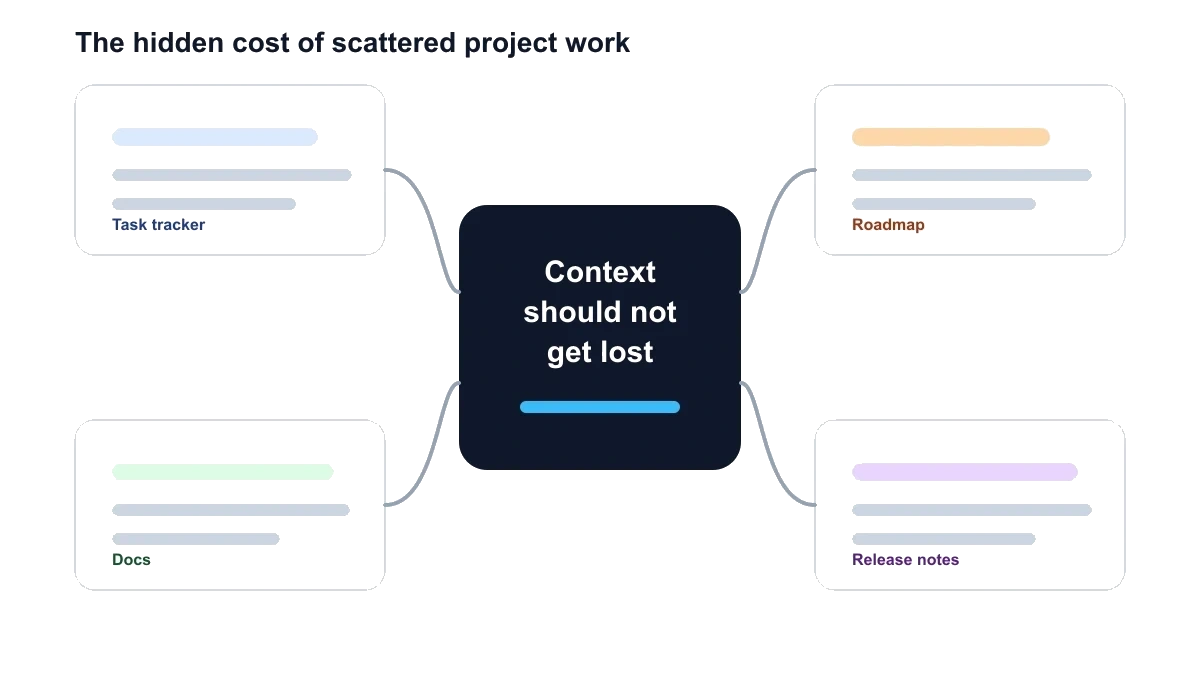
Open the task. Find the doc. Search the chat. Check the roadmap. Ask whether the decision changed. Look for the release note. Compare what the plan says with what the team actually shipped. Then, after all of that, do the work.
Each switch feels small enough to ignore. Together, they become the operating cost of the team.
The Real Cost Is Reconstruction
Most teams can tolerate moving between tools. That is not ideal, but it is not automatically fatal.
The harder problem is reconstruction.
Reconstruction happens when the team has to rebuild the answer to basic project questions:
- Why does this task exist?
- What decision created it?
- Did the roadmap change?
- Which release does this belong to?
- What is blocked?
- Who owns the next step?
- What did we already try?
- What context should not be lost?
If the answers live in different places, the task becomes a pointer to missing information. The team then relies on memory, chat archaeology, meetings, or the person who "knows the story."
That works until the project grows, the team gets busy, someone is unavailable, or enough time passes that nobody remembers the original reason.
A Task Is Rarely Enough
A task can describe work, but it rarely explains the whole situation.
Useful execution usually needs surrounding context:
- the customer problem or internal reason
- the decision that shaped the scope
- the dependency that affects timing
- the roadmap item it supports
- the release it is expected to land in
- the doc that explains the tradeoff
- the change that happened since the task was created
When that context stays outside the work, the task becomes shallow. It may still be accurate, but it is not enough to help someone make a good decision.
This is where teams lose time in a way that does not show up cleanly on a dashboard. The work is technically documented, but the connections are weak. People are not asking for status because they enjoy status updates. They are asking because the system is not carrying enough context forward.
Roadmaps Become a Parallel Reality
Roadmaps are useful when they help teams decide what to do next.
They become expensive when they drift away from execution.
I have seen this pattern often: the roadmap says one thing, the task board says another, the decision doc is stale, and the release plan has a slightly different story. Nobody is necessarily being careless. The work moved, but the plan did not move with it.
The meeting then becomes a negotiation about which system is telling the truth.
That is a costly kind of context switching. The team is not switching from tool to tool because the tools are interesting. They are switching because no single view is trustworthy enough to make the next decision.
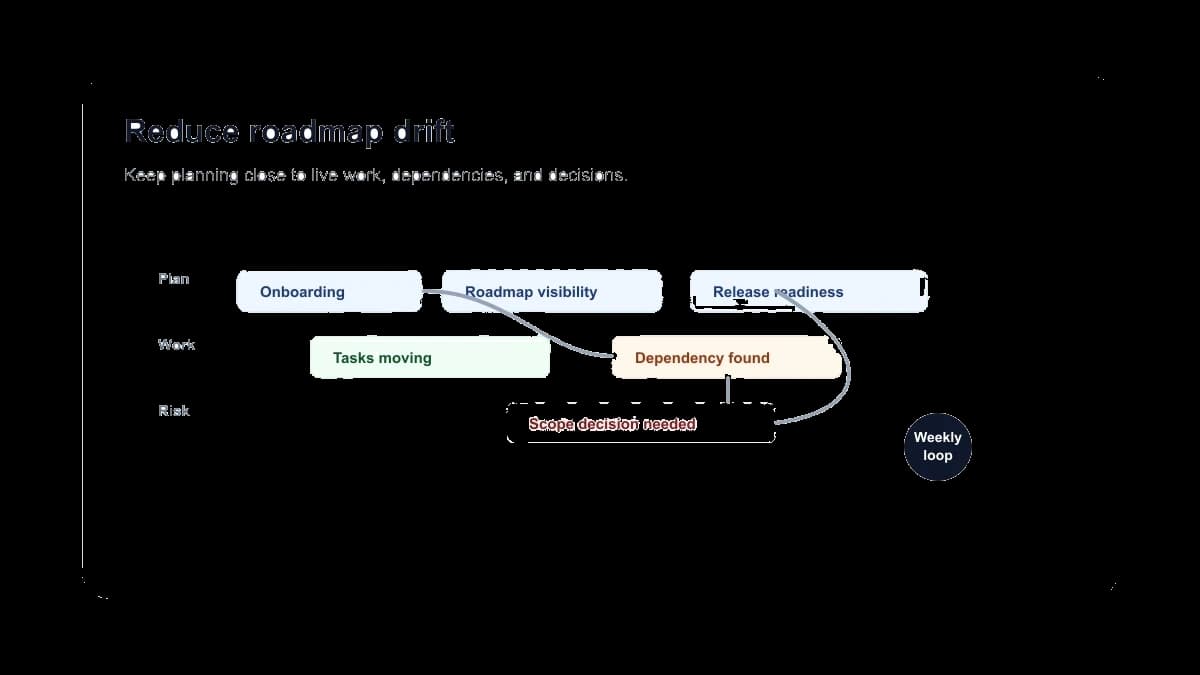
A roadmap should stay close to the work it represents. If a task changes scope, the roadmap should make that visible. If a dependency appears, the roadmap should show the delivery risk. If a release date moves, the reason should not be buried in a thread.
The roadmap should be part of execution, not a presentation artifact that has to be reconciled later.
Documentation Drifts When It Is Too Far From Delivery
Documentation has the same failure mode.
Teams write docs with good intentions. The decision gets captured. The product behavior is described. The technical constraint is explained. Then implementation moves, scope changes, the release gets split, or an edge case appears.
The doc does not always move with the work.
Now the team has two problems:
- The doc may be stale.
- Nobody knows exactly which part is stale.
That creates quiet distrust. People stop relying on the docs because they are not sure whether the docs are current. More knowledge moves into chat, meetings, and memory. The next person has to ask again.
Good documentation does not need to become a giant manual. It needs to stay close enough to delivery that people can trust the parts that matter.
Releases Should Preserve Memory
Release tracking is another place where teams quietly lose context.
If release notes are written after the fact, the team has to reconstruct what shipped. If shipped work is not connected back to tasks and decisions, the release becomes a summary without evidence. If the release plan lives away from the actual work, customer communication and internal learning both get weaker.
Shipping should leave a usable record:
- what changed
- why it changed
- which tasks shipped
- what was split or deferred
- what users or stakeholders need to know
- what the team should remember next time
That record is part of the team's memory. When it is disconnected, future planning starts from a weaker place.
AI Can Multiply the Problem
AI changes the speed of output. It can summarize, draft, rewrite, classify, and generate plans quickly.
That can help, but only if the generated output connects back to the project system.
If an AI summary does not become a decision, it fades. If an AI-generated task does not preserve the reason behind it, it becomes another item in the backlog. If an AI status update is written from partial context, it can make the project sound clearer than it is.
This is why I think AI in project work has to be judged by more than generation quality.
The useful question is: did the project state become easier to trust afterward?
AI should help reduce reconstruction. It should connect tasks, docs, roadmaps, releases, and decisions. It should surface what changed. It should ask for confirmation when the action affects delivery. It should operate inside the workflow, not create another pile of artifacts that someone has to sort later.
The Better Question Is Where Context Lives
When I think about project tools, I keep coming back to one question: where does context live?
If context lives only in a person's head, the team depends on that person.
If it lives only in chat, it becomes hard to retrieve.
If it lives only in docs, it can drift away from execution.
If it lives only in tasks, it can become too shallow.
The answer is not to cram everything into one giant page. The answer is to connect the objects that already matter.
Tasks should connect to docs. Docs should connect to decisions. Roadmaps should connect to live work. Releases should connect to the tasks that actually shipped. AI and voice should operate inside that structure instead of outside it.
That is how context switching gets reduced in a meaningful way. Not by pretending people will never change screens, but by making sure each screen carries the project state forward.
How I Think About This in Bisonflow
Bisonflow is being built around a more connected project workspace: tasks, docs, roadmap planning, release tracking, voice capture, and AI-assisted workflows close together.
The goal is not to add more process. The goal is to reduce the manual work of keeping context alive.
When a builder captures an idea by voice, the product should help turn it into structured work instead of a forgotten note. When a task changes, the surrounding context should remain visible. When a roadmap item shifts, the team should see why. When a release ships, the work should leave a record the team can use later.
That is the practical problem: less reconstruction, less scattered context, and more trustworthy project state.
The Practical Standard
Context switching will never disappear completely. Teams will still use multiple tools, ask questions, write docs, review plans, and make judgment calls.
The standard is not zero switching. The standard is less reconstruction.
A good project system should make it easier to answer:
- What is true right now?
- What changed?
- Why did it change?
- What work does this affect?
- What should happen next?
- What should we remember later?
If the system can answer those questions without forcing the team to rebuild the story every time, it is doing real work.
That is the version of project management software I want Bisonflow to become: not another place to manage the work, but a workspace that helps the work keep its context as it moves.
Anthony Abramo
Founder, Bisonflow
Building voice-first project operations for product and engineering teams.