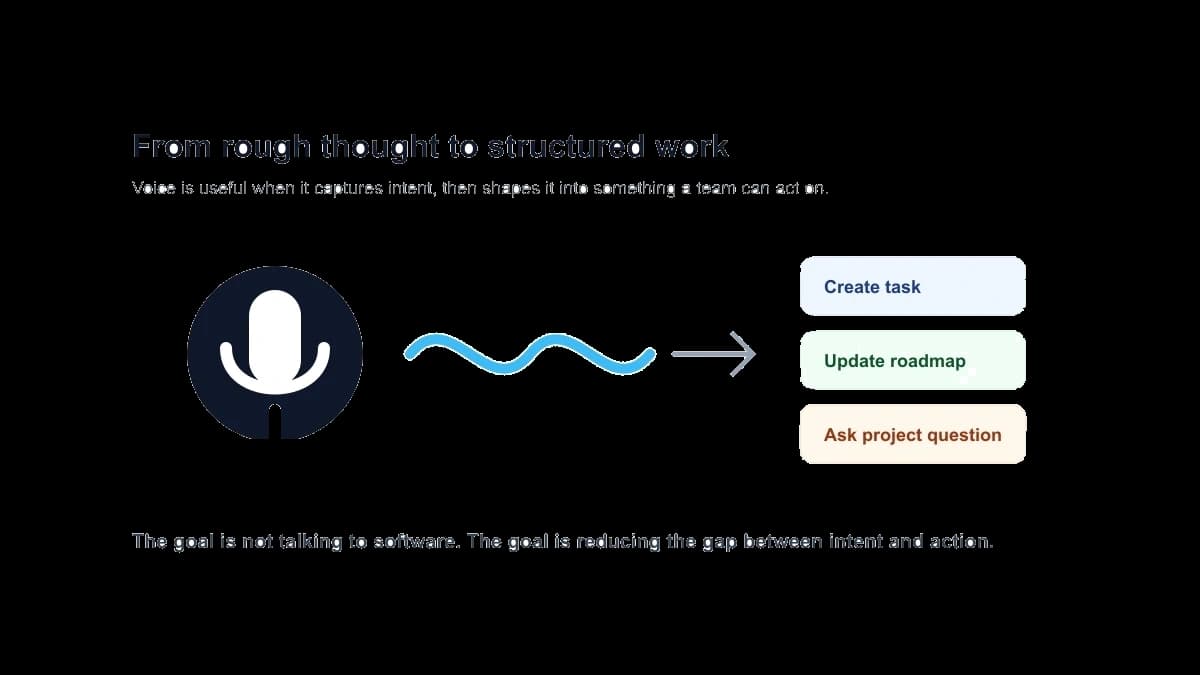
AI is already inside project work. It writes meeting notes, drafts tickets, summarizes customer feedback, turns calls into action items, rewrites specs, answers project questions, and helps people move from a messy thought to a presentable artifact faster than before.
That is useful. It is also not the same thing as better project execution.
The state of AI in project management in 2026 is not really an adoption story anymore. Teams are using the tools. The harder question is whether the project workflow can absorb the speed without turning into more scattered context, more disconnected artifacts, and more coordination work for the humans in the middle.
Adoption Has Moved Faster Than Workflow Design
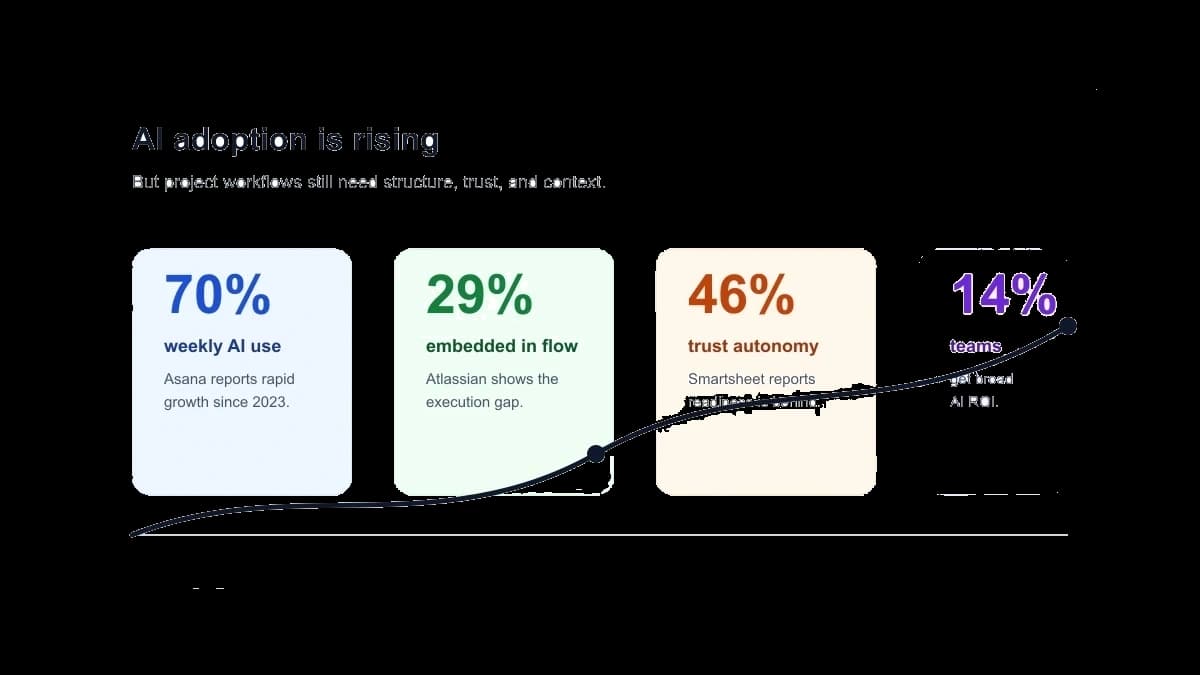
The adoption numbers are hard to ignore. Asana's 2025 State of AI at Work shows weekly AI use among knowledge workers rising from 36% in 2023 to 70% in 2025. Slack's Workforce Index reported in June 2025 that 60% of desk workers were using AI, with daily usage 233% higher than it was in November 2024.
In project and portfolio management specifically, Smartsheet's 2026 Project and Portfolio Management Priorities Report says 97% of PPM professionals are experimenting with AI, while fewer than half trust it to act without human supervision.
That last detail matters. It points to the real issue: people are willing to use AI, but they do not yet trust the surrounding system enough to let AI act deeply inside delivery work.
That is a rational hesitation. Project management is not just text generation. It is decisions, dates, owners, dependencies, constraints, scope changes, customer promises, stakeholder expectations, release history, and the little bits of context that explain why something is being done at all.
If AI is disconnected from that structure, it can help create output while still leaving the team to reconcile the work manually.
The Real Problem Is Context Decay
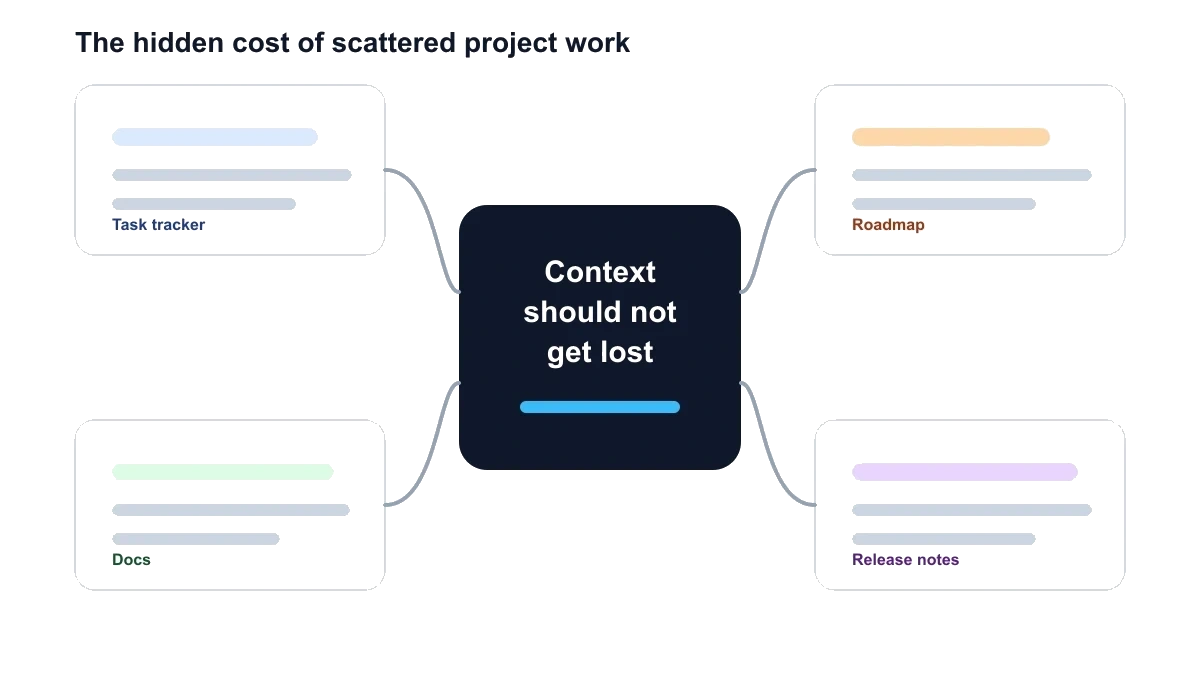
Project work decays when context does not stay attached to the thing it explains.
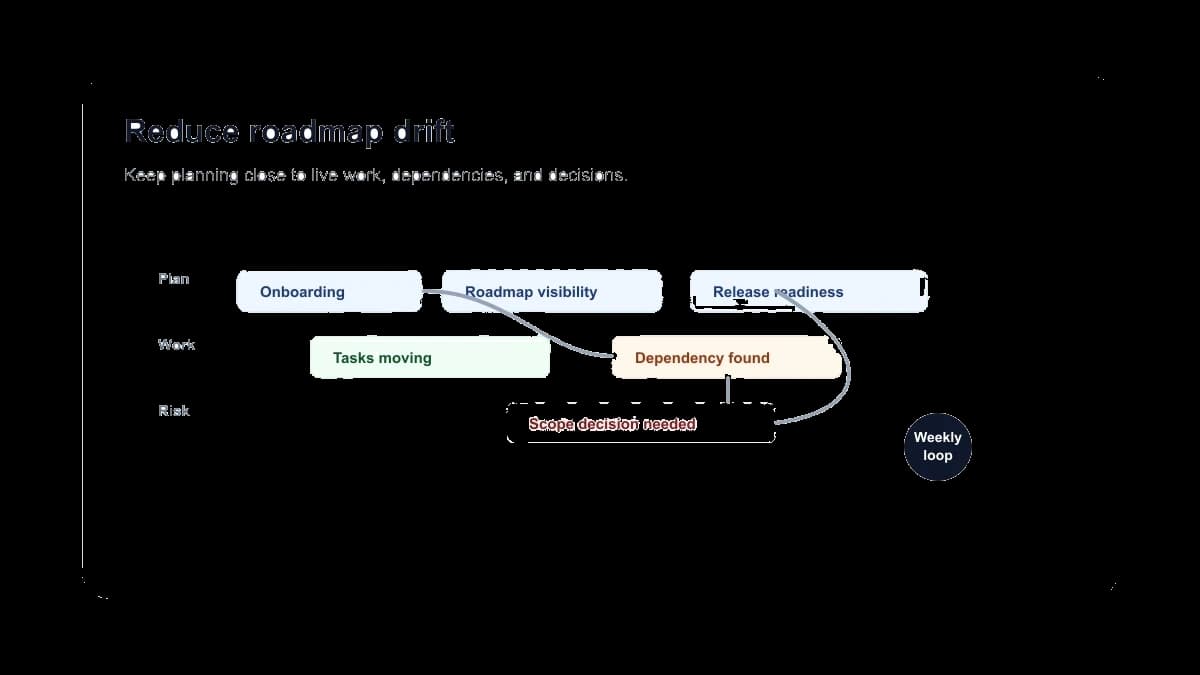
A roadmap item loses the reason it was prioritized. A task loses the customer pain behind it. A decision gets made in chat and never reaches the doc. A release slips because a dependency was mentioned once in a meeting, then disappears into memory. A status update sounds current, but it was written from partial information.
Teams usually patch this with human coordination:
- someone remembers the backstory
- someone searches the chat
- someone asks for the latest status
- someone rewrites the roadmap
- someone updates the spreadsheet
- someone turns a meeting into tasks
- someone checks whether the task, doc, and release plan still agree
AI can make those motions faster. It can also multiply them.
If every person can generate more drafts, tasks, summaries, and plans, the shared system has more material to absorb. The bottleneck moves from creation to coordination. The team has to decide what is true, what changed, what matters, and what should happen next.
That is where many AI features in project tools still feel shallow. They are good at helping one person produce something. They are weaker at preserving the state of the project.
The Fragmentation Tax Is a Team Problem
Atlassian's 2026 State of Teams puts useful language around this with the idea of an "AI fragmentation tax." The report says 85% of knowledge workers use AI at work, but only 29% have embedded it into their flow of work. It also says 87% of knowledge workers feel that, with everyone in execution mode, they lack the time or capacity to coordinate.
That is the project-management problem in plain terms. AI makes execution feel faster at the individual level, but team delivery still depends on coordination.
A developer writing code faster does not automatically mean the release ships faster. A product manager drafting specs faster does not automatically mean the team understands the tradeoff. A founder generating a backlog faster does not automatically mean the right thing is being built.
The project system has to answer boring but critical questions:
- What is the current priority?
- Who owns the next step?
- Which decision changed the plan?
- What dependency is blocking the release?
- Which tasks actually shipped?
- What context should be carried forward?
- What should the AI be allowed to change?
Those questions are not glamorous, but they are where delivery risk lives.
Generic AI Sits Beside the Work
Most teams already have access to generic AI. That is not the gap.
The gap appears when a tool can draft a good status update but does not know whether the underlying work changed. It can summarize a meeting but does not know which action items belong to which release. It can rewrite a spec but does not understand the roadmap decision that made part of the spec obsolete. It can answer a question from a prompt, but not from the actual shape of the project.
This is why "AI project management" cannot just mean a chat box bolted onto a task board.
A project workspace has domain objects:
- tasks
- docs
- comments
- roadmaps
- releases
- owners
- priorities
- dependencies
- due dates
- workflow states
AI becomes more useful when it can operate with those objects, not just around them. It needs to know whether it is drafting a note, changing a task, proposing a plan, summarizing a release, or asking for human confirmation because the action would affect delivery.
Without that structure, AI is mostly a faster writing layer. With it, AI can start becoming part of the workflow.
Trust Depends on Boundaries
Trust in AI for project work is not only about model quality. It is about boundaries.
People need to know what the system saw, what it changed, what it inferred, and what still needs judgment. That is especially true in project management because a wrong answer can create real operational noise. A bad task description is annoying. A bad ownership change, stale roadmap update, or incorrect release summary can mislead a team.
The useful standard is not "let AI do everything." That is vague and usually irresponsible.
A better standard is:
- AI should preserve the source context behind its output.
- AI should distinguish suggestions from committed changes.
- AI should act inside clear workflow permissions.
- AI should make its reasoning inspectable enough for review.
- AI should keep project objects connected after it creates or changes them.
That is how AI earns more responsibility in project work. Not by sounding confident, but by staying tied to the system of record and giving humans a clean way to correct it.
How I Think About This in Bisonflow
This is the product lens I am using while building Bisonflow.
I do not want Bisonflow to be a chatbot that happens to sit next to a project management app. I want the workspace itself to understand project context well enough that AI can help inside the work: capturing ideas, structuring tasks, connecting docs, planning roadmaps, tracking releases, and carrying decisions forward.
That is a harder product problem than adding an AI button. It means the underlying objects have to matter. Tasks cannot be isolated rows. Docs cannot be dead pages. Roadmaps cannot be presentation artifacts. Releases cannot be detached changelogs. Voice input cannot just become a transcript. The pieces need relationships.
For a small team or solo builder, this matters because there is rarely a dedicated project manager keeping the system tidy. The person building is often also the person planning, writing, prioritizing, shipping, and updating stakeholders. If the tool creates more cleanup work, it loses.
So the practical goal is simple: capture work quickly, keep enough structure for the system to reason about it, and reduce the manual effort of reconnecting context later.
Bisonflow is early, and I am not pretending it has solved the whole category. But this is the bar I am building toward: AI that respects project state instead of producing more disconnected project debris.
The Practical Standard for 2026
The winning AI project-management tools will not be the ones with the longest feature list or the loudest claims about automation. They will be the tools that help teams keep intent, context, decisions, and delivery connected as the volume of AI-generated work increases.
That means the important questions for teams are changing:
- Does this AI understand the project objects we already work with?
- Can it preserve context across tasks, docs, roadmaps, and releases?
- Does it reduce coordination work, or just create more artifacts?
- Can humans review and correct its actions without digging through prompts?
- Does it make delivery state clearer after it runs?
AI adoption is already here. The workflow is the part that still needs to mature.
For project teams, that is the 2026 state of the market: generation is becoming cheap, but trustworthy coordination is still expensive.
Anthony Abramo
Founder, Bisonflow
Building voice-first project operations for product and engineering teams.