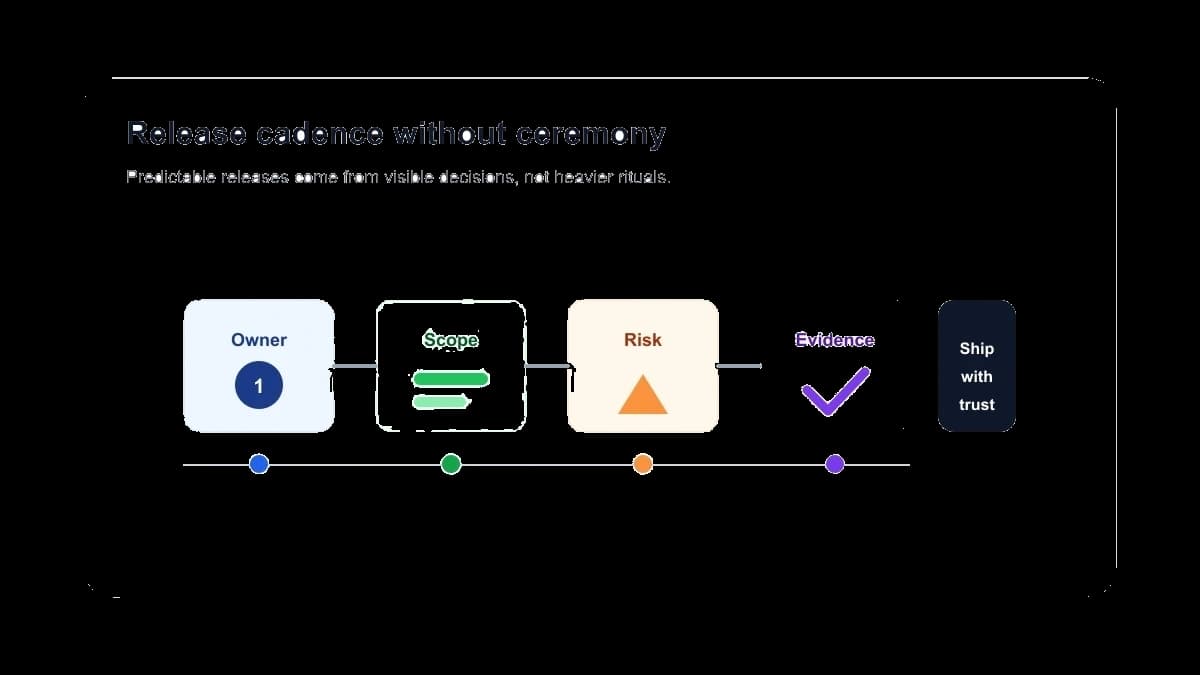
Release cadence improves when teams reduce ambiguity.
It usually does not improve because the team adds more rituals. More meetings can make a release feel managed while the real risks stay unclear. More status updates can create the appearance of control while scope, ownership, and readiness are still fuzzy.
The better version is simpler: make release state visible enough that the team can make decisions before the release is already slipping.
That is the kind of release planning I want Bisonflow to support. Not ceremony for the sake of ceremony, but a practical rhythm that helps teams know what is shipping, why it is ready, what changed, and what should be remembered later.
Cadence Is a State Problem
Teams often treat release cadence as a calendar problem.
Ship every week. Ship every two weeks. Ship at the end of the sprint. Ship when the milestone is done.
The calendar matters, but it is not enough. A release date only helps if the team can understand the release state underneath it:
- what is in scope
- what is out of scope
- what changed
- what is blocked
- what evidence says the release is ready
- what risk is still open
- what work actually shipped
If those answers are scattered across tasks, docs, chat, roadmap notes, and memory, the team will compensate with meetings. The meeting becomes the place where everyone reconstructs the release.
That is the part worth fixing.
Start With One Release Owner
Every release needs one clear owner.
That does not mean one person does all the work. It means one person is responsible for keeping the release state understandable.
The owner should be able to answer:
- What is included?
- What is excluded?
- What is blocked?
- What changed since the last check?
- What decision is needed next?
- What would make this release unsafe or misleading?
Without an owner, release risk gets distributed so widely that nobody is actually tracking the full picture. Everyone knows a piece. Nobody knows the release.
That is when problems show up late.
Define Scope in Plain Terms
Release scope should be explicit enough that the team can make tradeoffs.
This does not need to become a giant release document. It needs to answer a few practical questions:
- What user-facing or operational outcome is this release supposed to create?
- Which tasks or changes are included?
- Which work is intentionally deferred?
- Which roadmap item or milestone does this support?
- What customer, support, or internal context needs to be carried forward?
The out-of-scope list matters as much as the in-scope list. If the team does not name what is waiting, people keep assuming it might still make the release. That creates pressure, late surprises, and vague conversations about whether the team is "almost done."
Clear scope is not bureaucracy. It is how teams protect the release from becoming a moving target.
Readiness Should Be Evidence-Based
"Are we ready?" is a weak release question because it invites confidence instead of evidence.
A better question is: "What evidence says this is ready to ship?"
That evidence might include:
- required tasks are complete
- known blockers are resolved
- acceptance criteria are checked
- documentation is updated
- release notes are drafted
- QA or test coverage has passed
- rollout risk is understood
- support or customer-facing context is prepared
- deferred work is explicitly recorded
The exact list depends on the team and the product. The principle stays the same: readiness should be based on visible signals, not vibes.
This also makes release conversations calmer. The team is not debating whether someone feels good about shipping. The team is checking whether the evidence is strong enough.
Use One Useful Risk Checkpoint
Most teams do not need more status meetings. They need one useful risk checkpoint.
Once per week, or more often near a launch, ask:
- What changed since the last check?
- What could delay this release?
- What scope should move out now instead of later?
- What decision is blocked?
- What evidence is still missing?
This should be short. If the checkpoint becomes a long meeting, the workspace is probably not giving the team enough visibility outside the meeting.
The goal is not to narrate every task. The goal is to surface release risk while the team still has room to act.
Correct Scope Early
When a release starts slipping, teams often respond by working harder around the edges.
That can help for a day or two, but it can also hide the real problem. More parallel work creates more coordination, more review, and more risk. If the scope is wrong, speed alone will not fix it.
The better response is early scope correction.
That might mean:
- move a nonessential task out
- split the release
- reduce the public promise
- ship the core workflow first
- hold a risky change until the next release
- escalate the blocked decision now
This is not lowering standards. It is protecting delivery quality.
A release that ships a smaller, coherent outcome is usually better than a release that absorbs everything and becomes hard to trust.
Keep the Release Connected to Tasks
Release planning becomes painful when the release is disconnected from the work.
If the release note says one thing and the task history says another, someone has to reconstruct the truth manually. If shipped tasks are not connected to the release, the team loses a useful record. If deferred work is not captured, the same questions come back later.
A release should connect back to the tasks that actually shipped.
That creates a clean record:
- what changed
- when it shipped
- why it mattered
- what work made it possible
- what was deferred
- what context support, customers, or the team needs next
That history is useful for product planning, customer communication, support, internal review, and future roadmap decisions.
The release is not just an event. It is part of the team's memory.
AI Can Help If It Has the Release Context
AI can help with release work, but only if it can see the relevant project state.
Generic generation can draft a release note. That is useful, but limited.
A more useful workflow can look at shipped tasks, linked docs, roadmap context, comments, and deferred work. It can suggest a release summary, surface missing evidence, flag unresolved blockers, and help record what changed.
That is the difference between writing about the release and understanding the release.
I do not want Bisonflow to use AI as decoration around release tracking. The useful version should reduce the manual work of reconstructing what shipped and why.
How I Think About This in Bisonflow
For Bisonflow, releases should stay close to tasks, docs, roadmaps, and decisions.
When work ships, the release should preserve the relationship between the change and the context behind it. When scope moves out, the release should remember what was deferred. When a roadmap item changes because of release reality, that connection should be visible.
That does not require a heavy release ceremony. It requires a workspace where release state is connected enough to trust.
The product direction is practical:
- one clear release owner
- visible scope and deferred work
- evidence-based readiness
- lightweight risk checks
- early scope correction
- release notes tied to shipped tasks
- AI that helps summarize and surface gaps from actual project context
That is enough structure for many teams. The goal is not to make release management feel bigger. The goal is to make shipping easier to understand.
The Practical Standard
Release cadence does not need theater. It needs a repeatable decision rhythm.
A healthy release loop should answer:
- What is shipping?
- Why is it ready?
- What changed?
- What is still risky?
- What moved out?
- What evidence supports the decision?
- What should the team remember later?
If the team can answer those questions without a heavy ritual, the cadence is probably healthy.
That is the standard I want Bisonflow to support: releases that are predictable because the state is clear, not because the process is louder.
Anthony Abramo
Founder, Bisonflow
Building voice-first project operations for product and engineering teams.