Bisonflow is close to launch, and I am intentionally keeping the first audience narrow.
That is not a positioning trick. It is a product decision. Early software gets weaker when it tries to look ready for every company, every department, every methodology, and every edge case before it has proven the core workflow. I would rather be honest about the first users I am building for and learn from the people who can feel the problem without needing it explained.
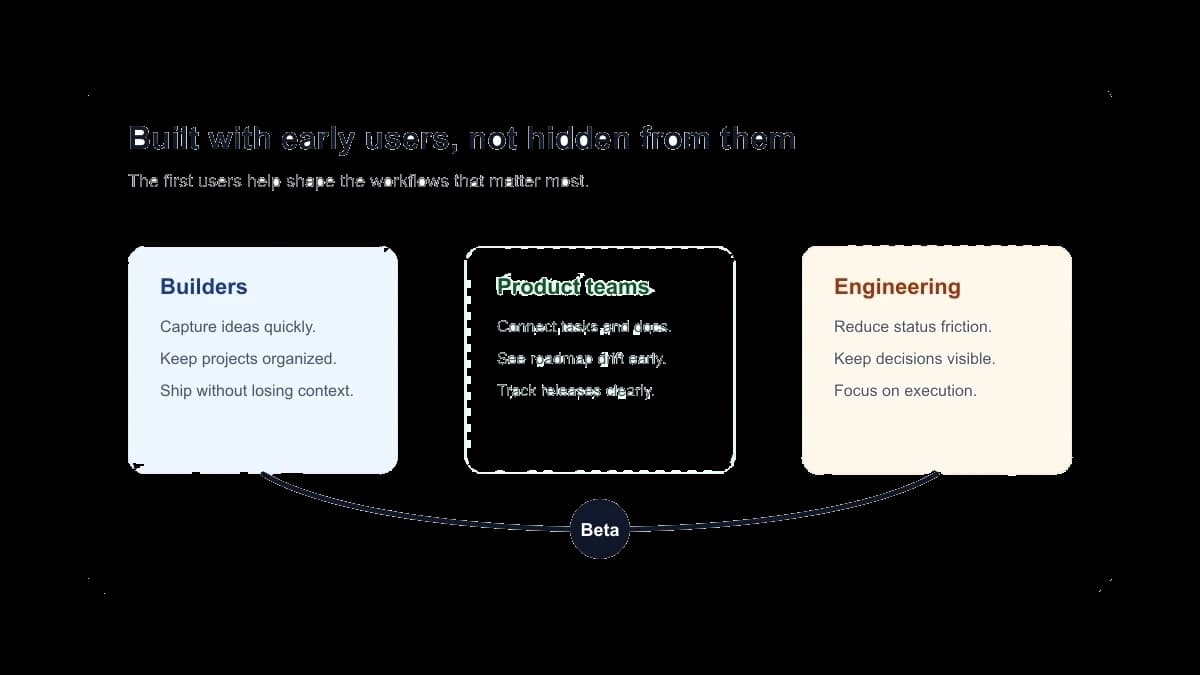
The first version of Bisonflow is for people close to the work: builders, founders, product teams, and engineering teams that need to move from idea to delivery without constantly rebuilding context.
The First Users Should Feel the Pain Directly
The best early users are not always the largest teams or the teams with the most formal process. For Bisonflow, the best early users are the people who personally deal with the workflow edges:
- the idea that never became a task
- the task that lost the reason behind it
- the roadmap item that drifted away from the actual work
- the release note written after everyone forgot what shipped
- the decision buried in chat
- the project update that required checking five places
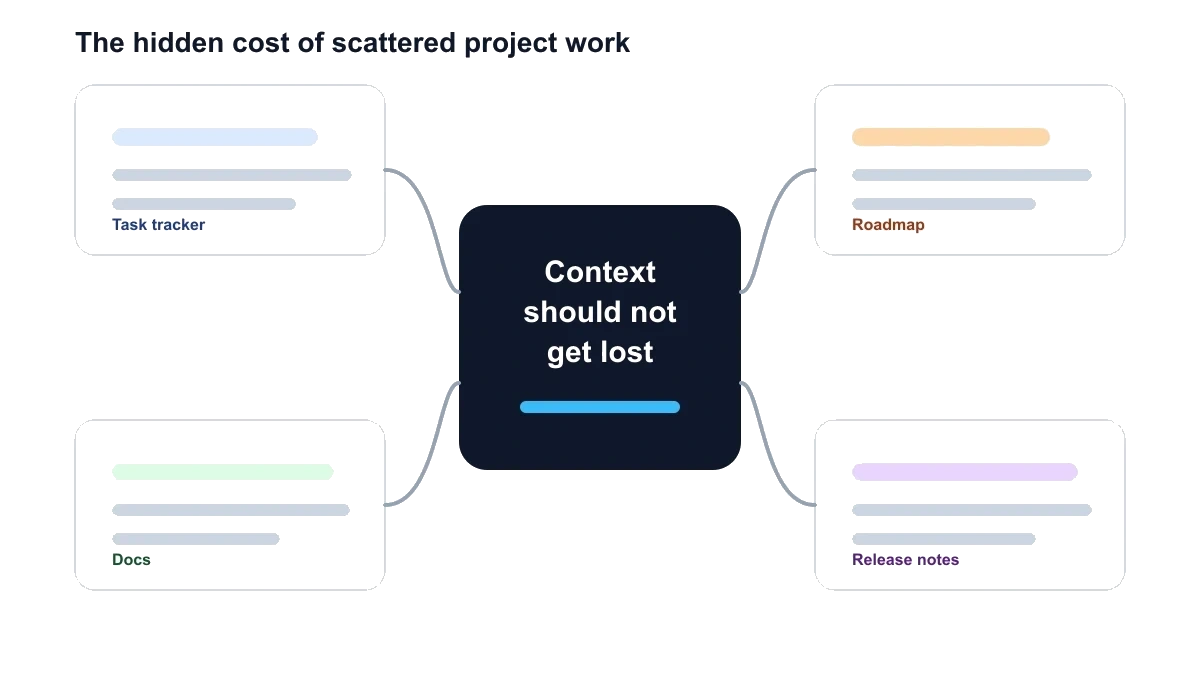
Those are not abstract project-management problems. They are the daily friction of trying to ship software when work, context, decisions, and plans live too far apart.
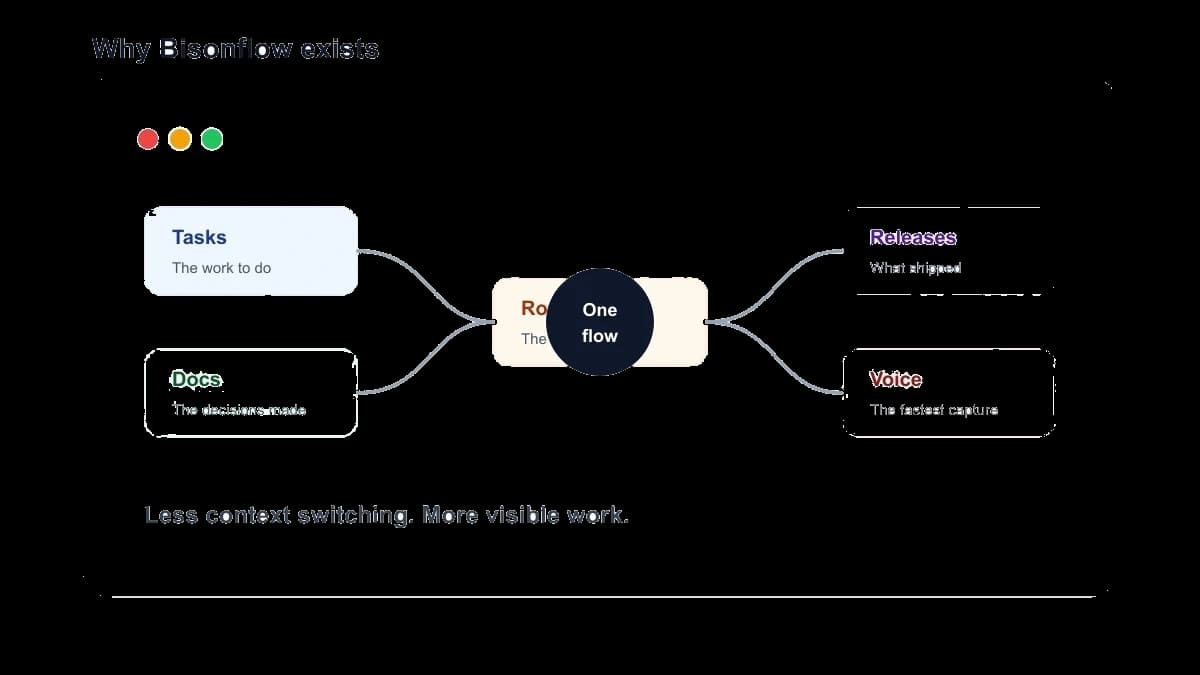
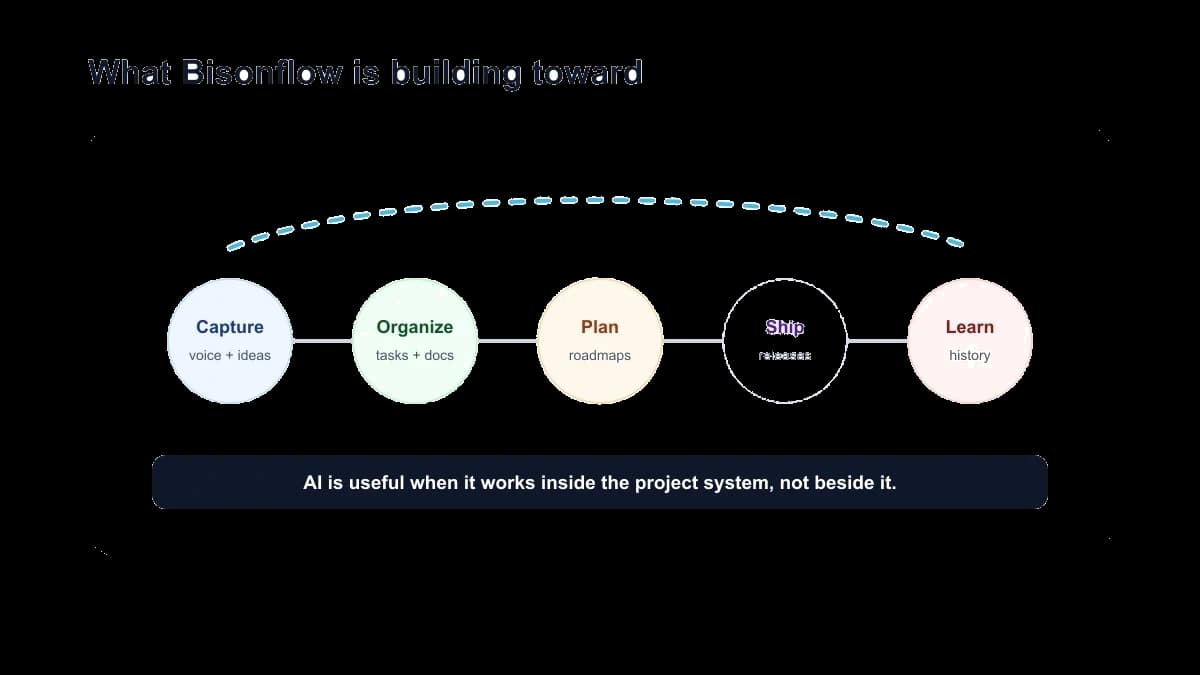
That is the pain Bisonflow is meant to reduce. Not with heavier process, and not with a giant enterprise suite on day one. The first version needs to prove something simpler: one workspace can help people capture, organize, plan, and ship work with less context loss.
Solo Builders and Founders
Solo builders and founders are a natural starting point because they feel the whole project at once.
One person may be handling product, engineering, customer feedback, launch planning, content, support, pricing, bugs, and roadmap decisions in the same day. That can move fast, but it also means context has nowhere safe to go unless the system makes it easy.
The problem is not that solo builders need a heavyweight project-management ritual. They usually need the opposite. They need a fast way to capture the thing they just noticed, turn rough intent into structured work, keep the reason attached, and see what should happen next.
For this group, Bisonflow should be useful even before there is a team around it. If a founder can use voice to capture a product thought, turn it into a task, connect it to a doc, place it in the roadmap, and remember it when planning a release, that is a strong signal. It means the workflow has value at the smallest useful scale.
Small Product Teams
Product teams live in tradeoffs.
They are constantly balancing customer feedback, stakeholder requests, product judgment, engineering constraints, scope, timing, and release quality. The hard part is not only creating tasks. The hard part is keeping the reason behind the work visible after it enters execution.
A customer comment becomes a feature idea. The feature idea becomes a roadmap item. The roadmap item becomes tasks. The task changes after engineering finds a constraint. The release gets split. The original decision still matters, but it is now scattered across a call note, a chat thread, a ticket, and a planning doc.
That is exactly where project tools can become brittle. They store the objects, but the relationships between the objects are weak.
For product teams, Bisonflow should make it easier to answer:
- Why are we doing this?
- What changed since we planned it?
- Which tasks make this roadmap item real?
- What is blocked before this can ship?
- What decision should future us remember?
If the product helps answer those questions without making the team maintain a complicated system by hand, it is doing something useful.
Engineering Teams
Engineering teams do not need vague process wrapped around their work. They need clear context and low-friction updates.
An engineer needs to know what should be built, why it matters, what changed, what is blocked, where the decision lives, and what "done" means for the release. When those answers are missing, the team pays for it through interruptions, status meetings, rework, and quiet misalignment.
I do not want Bisonflow to make engineering work feel more managed for the sake of management. I want it to make project state easier to trust.
That means tasks should carry enough context to be useful. Docs should stay close to execution. Roadmaps should reflect real work, not a parallel promise. Releases should preserve what shipped. AI and voice should help update the system without creating another pile of cleanup.
For engineering teams, the question is practical: does Bisonflow reduce the amount of time spent chasing context?
The Feedback I Actually Need
At this stage, the most useful feedback is not "can you add every integration?" or "can this support every workflow we might need someday?"
Those questions will matter later. The first question is whether the core loop works.
I want feedback from early users on things like:
- Did you capture work faster than your current process?
- Did the product preserve enough context for the task to be useful later?
- Did voice input feel practical, or did it create cleanup?
- Did docs, tasks, roadmaps, and releases feel connected?
- Did the roadmap help you make a real planning decision?
- Did release tracking help you remember what shipped?
- Did Bisonflow reduce context switching, or did it become another place to maintain?
- Where did the product feel heavier than the problem?
That last question matters. A project tool can fail by being too thin, but it can also fail by being too demanding. I am trying to build something that gives structure without making the user serve the tool.
What Bisonflow Is Not Yet
Bisonflow is not yet a mature enterprise platform. It is not trying to replace every tool in a large company on day one. It is not built around every compliance requirement, custom approval chain, reporting layer, or deeply specific methodology.
That is deliberate.
The first version should prove the foundation before the surface area expands. If Bisonflow cannot help a builder or small team keep work connected from idea to delivery, more enterprise features will not fix the underlying product. If it can, then the product has a real direction to grow from.
The launch version is a test of the workflow, not a claim that the category is finished.
The Practical Filter
The practical filter is simple.
Bisonflow is likely for you early if you are close to product or engineering work, you are responsible for turning ideas into shipped work, and you regularly lose time reconnecting tasks, docs, roadmaps, decisions, and releases.
It is probably not for you yet if you need a fully mature enterprise rollout, a large procurement process, or years of specialized workflow configuration before the product can be useful.
That is fine. Good early products need a clear edge.
For Bisonflow, the edge is this: help builders and small teams keep project context alive while they move from capture to planning to shipping. If the first users can feel that difference, the product is worth expanding.
Anthony Abramo
Founder, Bisonflow
Building voice-first project operations for product and engineering teams.