I am building Bisonflow because I kept seeing the same project problem from different seats.
As a full-stack developer, I wanted fewer interruptions, clearer priorities, and enough context to build without asking the same questions twice. As an agile coach, I wanted teams to see their work clearly, make better tradeoffs, and stop using meetings as the glue between disconnected tools.
Those roles look different from the outside, but they point at the same gap.
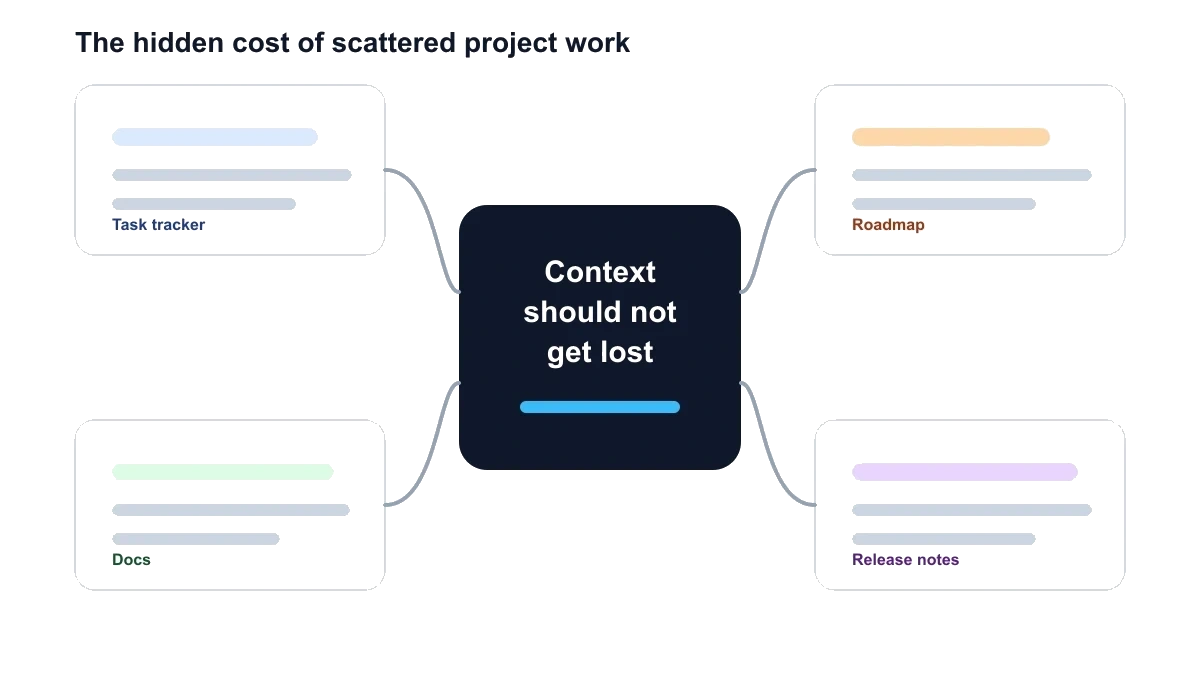
Project context appears in one place. Execution happens in another. By the time the team needs the context again, someone has to reconstruct it from memory, chat, docs, tickets, roadmaps, meetings, and release notes.
That gap is the reason Bisonflow exists.
The Problem Was Rarely Effort
Most teams I have worked around were not struggling because people did not care.
The problem was usually more mundane. The work was spread across too many places, and the connections between those places were weak.
Tasks lived in one tool. Decisions lived in another. Roadmaps sat in slides, spreadsheets, or a planning app. Release scope was discussed in meetings, then partially captured somewhere else. Important context appeared in chat. A customer detail stayed in a call note. A technical constraint lived in someone's head until it became urgent.
None of those tools were necessarily bad. Many were good at their own job. The failure happened between them.
That between-space is where teams lose time:
- asking where a decision was written
- checking whether the roadmap still matches the work
- explaining why a task exists
- turning meetings into follow-ups
- rewriting the same status in multiple places
- reconstructing what shipped after the release is already out
- depending on one person to remember the full story
The work is visible, but the relationships are not.
Developers Feel This as Interruption
From the developer seat, scattered context usually shows up as interruption.
You are trying to build, but the task is missing the reason behind it. You need to know whether the edge case matters for this release. You are not sure whether the roadmap changed. The doc says one thing, the task says another, and the answer is probably in a thread somewhere.
Sometimes the interruption is a meeting. Sometimes it is a message. Sometimes it is the quiet mental tax of checking three tools before you can trust the next step.
That does not mean developers should never ask questions. Good teams talk. But the system should not force people to chase context that already existed once.
When project context stays close to the work, developers can make better decisions without turning every question into a coordination loop.
Teams Feel This as Drift
From the coaching and team-systems side, the same problem looks different.
It looks like roadmap drift. It looks like stale documentation. It looks like status meetings that are mostly archaeology. It looks like a release plan that no longer matches the work because the important changes happened outside the planning artifact.
Teams compensate with process. More check-ins. More updates. More fields. More rituals. Sometimes that helps, but it can also make the system heavier without fixing the underlying issue.
The goal should not be more ceremony. The goal should be clearer project state.
The team should be able to understand:
- what changed
- why it changed
- who owns the next step
- what is blocked
- what is still true
- what is ready to ship
- what should be remembered later
That is not bureaucracy. That is the basic operating state of a project.
AI Makes the Gap More Important
AI is becoming part of everyday project work, and I think that makes this problem more urgent.
AI can write faster, summarize faster, generate tasks faster, and produce status updates faster. That is useful. But faster output does not automatically create a clearer project.
If AI lives outside the project system, it can create more artifacts for the team to reconcile. More drafts. More summaries. More plans. More task lists. More content that may or may not connect to the actual work.
That is why I am not interested in building Bisonflow as a task tracker with an AI sidebar. The useful version of AI needs to understand the project structure around it:
- the task
- the doc
- the roadmap item
- the release
- the owner
- the workflow state
- the decision behind the work
- the current context of the workspace
AI should help keep context alive, not create another place for it to disappear.
Why Voice Is Part of the Product
Voice matters to Bisonflow because a lot of project intent appears before someone is ready to write a clean task.
When you are testing a flow, reviewing a design, walking out of a customer call, or thinking through a release, stopping to open the right screen and format the perfect ticket can be enough friction to lose the thought.
That is not because people are lazy. It is because the capture cost is too high for the moment.
Voice can reduce that cost, but only if it creates structure. A pile of transcripts is not better project management. A rough spoken thought should be able to become a task, a doc note, a roadmap update, a release reminder, or a question about current project state.
For me, voice is not a gimmick and it is not the whole product. It is an input layer for preserving intent before it decays.
What I Want Bisonflow To Become
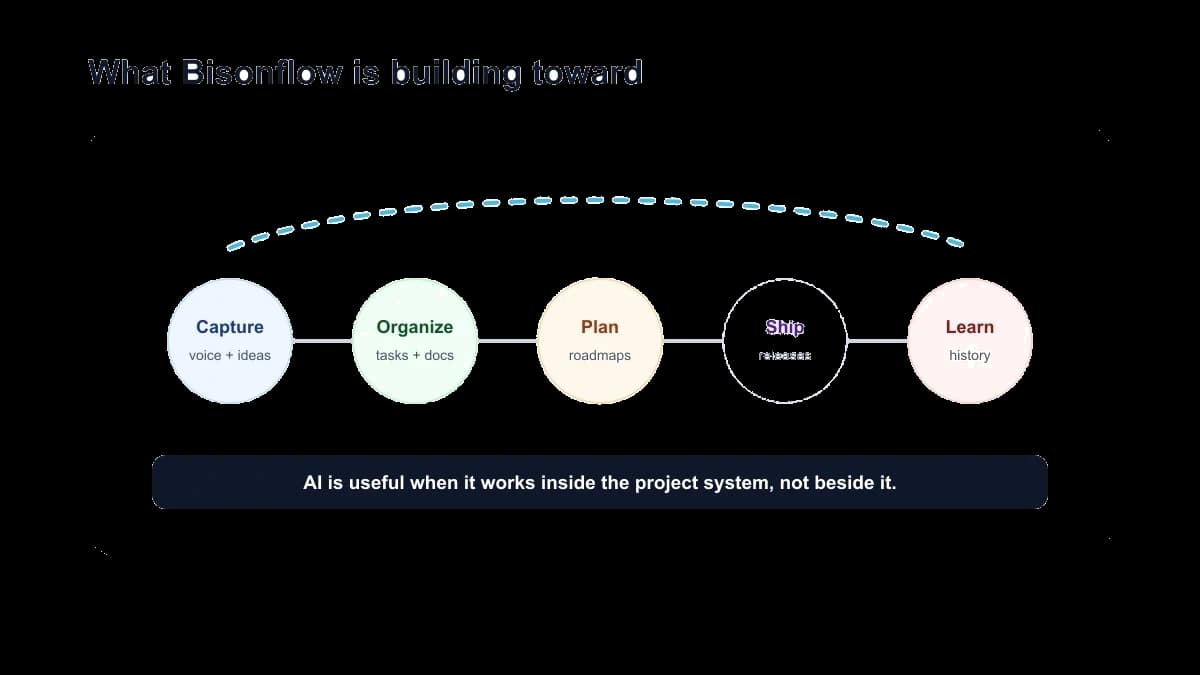
I want Bisonflow to become a practical workspace for moving project work from idea to delivery without constantly losing the thread.
That means:
- tasks that stay close to the reason behind them
- docs that stay connected to execution
- roadmaps that reflect real work and delivery risk
- releases that preserve what shipped
- voice capture that turns rough intent into structured work
- AI that operates with project context and clear boundaries
The product should not add process for its own sake. It should not become a dashboard that looks impressive but does not help anyone decide. It should not use AI to create more content while leaving the coordination work untouched.
The bar is more practical: does the workspace reduce the manual effort of keeping project context alive?
Why I Am Starting Small
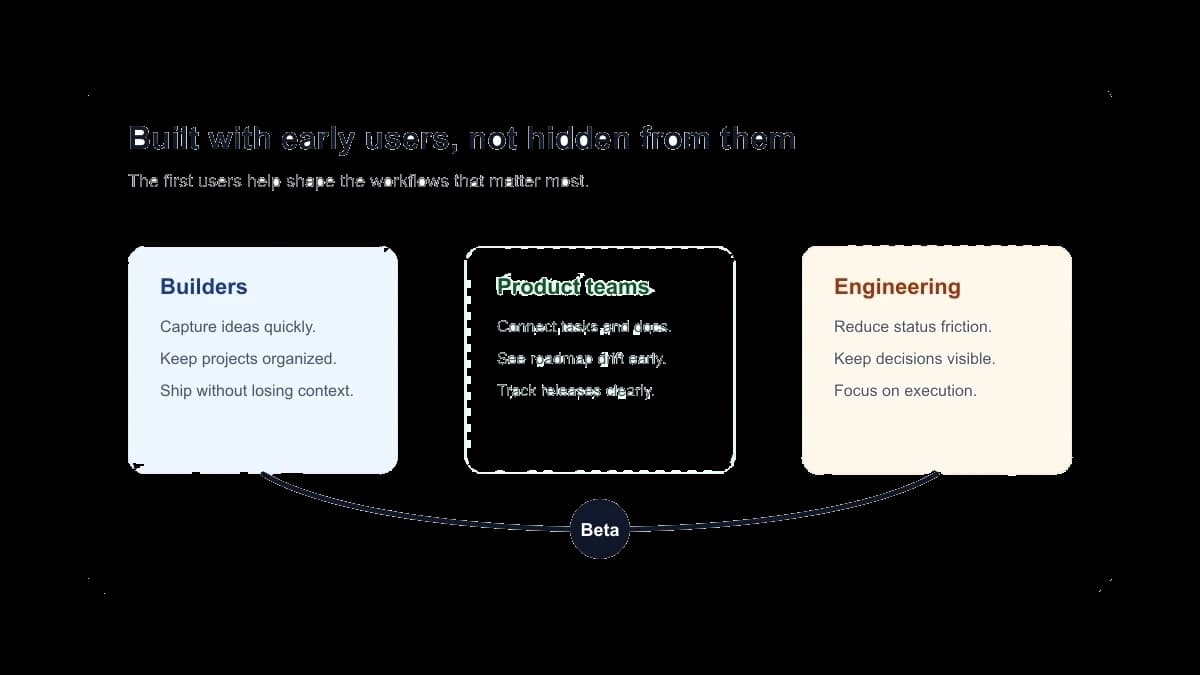
Bisonflow is starting with builders, founders, and small product teams because they feel the pain directly and the feedback loop is fast.
A solo builder does not have time to maintain a heavy system. A small team cannot afford to lose project context across five tools. A product-minded engineer needs enough structure to ship cleanly without spending the day managing the tool.
That is the early test.
If Bisonflow can help those users capture work faster, organize it with less friction, plan with clearer context, and remember what shipped, the foundation is worth expanding. If it cannot do that, more features will not save it.
I would rather prove the workflow with people close to the work than pretend the first version is already a full enterprise platform.
The Simple Reason
The simple reason I am building Bisonflow is that project work should not require so much reconstruction.
The team already had the conversation. Someone already made the decision. The reason already existed. The release already shipped. The context should not have to be rediscovered every time the project moves forward.
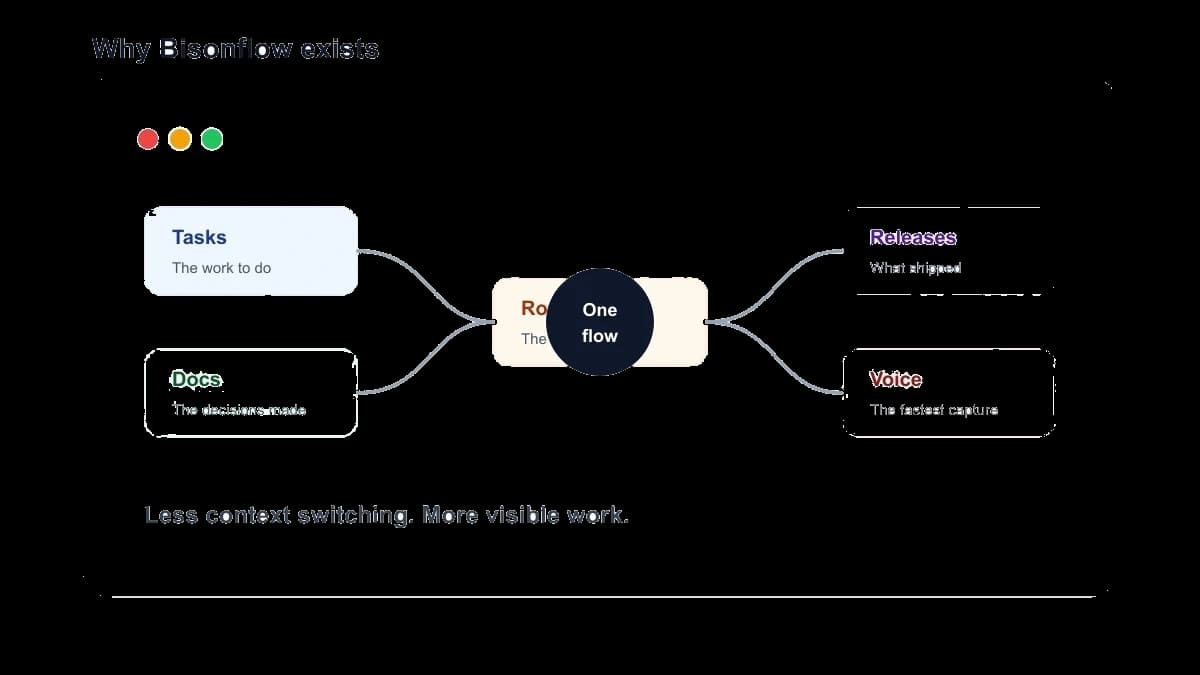
Bisonflow is my attempt to build a workspace where tasks, docs, roadmaps, releases, AI, and voice stay close enough together that the work keeps its memory.
It is early, but the reason is clear: software teams do not need more places to lose context. They need a better way to carry it from idea to delivery.
Anthony Abramo
Founder, Bisonflow
Building voice-first project operations for product and engineering teams.