Voice features in software deserve skepticism.
Most people have tried voice interfaces that were slower than typing, awkward in public, too brittle for real work, or useful only for simple commands. When a project management tool adds a microphone button, it is fair to ask whether that actually improves the workflow or just makes the product look more futuristic.
For Bisonflow, voice is not the point. Intent is the point.
Project work often starts before a person is ready to write a clean ticket, update a roadmap, or document a decision. A thought appears while testing a flow, reviewing a customer note, walking out of a call, checking a release, or looking at a task board and seeing something that does not line up.
Voice belongs in project planning when it helps capture that moment and turn it into structured project work before the context disappears.
The First Version of Work Is Usually Rough
Most project tools ask users to structure the thought before they capture it.
That works during focused planning. It works when you are sitting down to groom a backlog, write a spec, or update a roadmap. It does not work as well in the middle of real project motion.
The first version of a project thought usually sounds like this:
- "This onboarding bug needs to be fixed before launch."
- "The billing work is blocking team workspaces."
- "We should split this release because the reporting changes are not ready."
- "Add a note that the customer asked for CSV export, but only after filtering."
- "Move the roadmap item back unless the API cleanup ships this week."
- "What is still open before we can publish the changelog?"
Those are not polished tasks. They are fragments of intent mixed with context, priority, timing, risk, and memory.
If the capture process is too slow, the thought gets delayed. If it gets delayed, it often gets simplified. If it gets simplified, the team may keep the task but lose the reason behind it.
That is the real problem voice can help with.
The Value Is Not Dictation
Dictation is not enough.
If voice only turns speech into text, the product has moved the user from typing to talking, but the team still has to clean up the result. That may be useful sometimes, but it is not a project workflow.
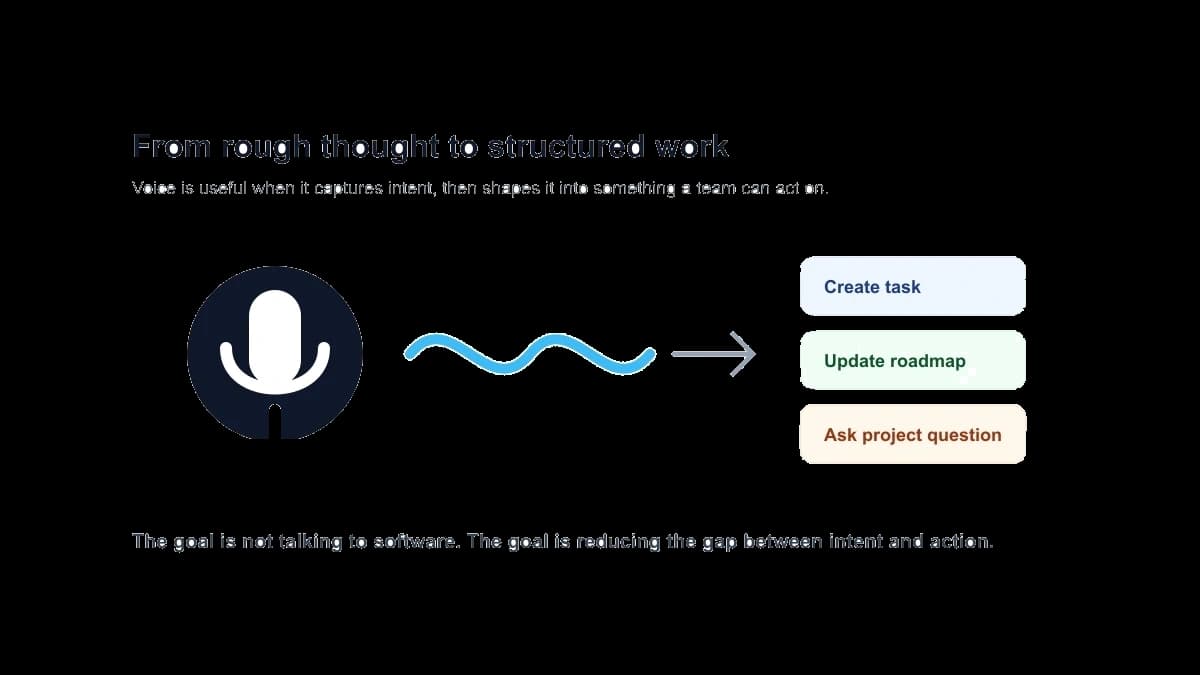
The useful version of voice does more than preserve words. It helps turn natural intent into the right project object:
- a task when there is work to do
- a doc note when there is context to preserve
- a roadmap update when the plan changes
- a release reminder when shipped work needs a record
- a project question when the user needs current state
- a workflow update when an existing task changes
That distinction matters. A voice note says, "Here is what I said." A voice workflow says, "Here is how this changes the project."
Bisonflow is being built around the second idea.
Voice Needs Project Context
The hard part of voice planning is not recording audio. It is understanding what the user meant inside the project.
If I say, "move the onboarding task to ready," the system needs more than a transcript. It needs to know which project I am in, which onboarding task I probably mean, what statuses exist, whether "ready" maps to a real workflow state, whether I have permission to change it, and whether the change should happen immediately or ask for confirmation.
If I say, "this should wait until billing is done," the system needs to understand whether I am talking about a dependency, a roadmap change, a release risk, or just a note.
That is why voice and AI need the project model around them:
- tasks
- docs
- comments
- roadmap items
- releases
- owners
- workflow states
- dependencies
- current workspace context
Without that context, voice becomes a looser input method. With that context, voice can become a lower-friction path into structured work.
Voice Can Make the Mess Worse
There is a real failure mode here: voice can create more clutter.
If every spoken thought becomes a note, the team gets another inbox. If every command produces a task without enough context, the backlog gets noisier. If the system acts too aggressively, people stop trusting it. If it asks for confirmation on everything, the workflow becomes slow again.
That is the product edge.
Voice should not be optimized for showing that the system understood a clever command. It should be optimized for whether the project state is clearer afterward.
A good voice workflow should usually do one of four things:
- capture intent before it disappears
- update existing work with less friction
- connect context to the right object
- answer a project-state question without forcing a search
If it does not do one of those things, it probably does not need to be a voice feature.
Where Voice Helps Most
I do not expect every project action to happen by voice. Some work should stay visual and deliberate.
Prioritization, detailed writing, architecture tradeoffs, careful roadmap review, and release scoping all need interfaces where people can compare, edit, and think. Voice should not replace that.
Voice is strongest in the moments where the user is trying not to lose momentum:
- capturing a task while reviewing a screen
- adding context after a customer call
- updating task state during implementation
- turning meeting takeaways into project actions
- asking what is blocked before a release
- adding a reminder while planning a roadmap
- navigating to the right project area without breaking focus
These moments are small, but they happen constantly. Project tools often lose users in exactly these small gaps, because the cost of opening the right screen and filling out the right fields is higher than the moment feels worth.
The result is not dramatic failure. It is slow context decay.
The Human Still Owns Judgment
Voice should make capture easier. It should not remove judgment.
A spoken thought is often incomplete. It may be emotional, imprecise, or missing a constraint. The system can propose structure, but the user still needs a clear way to review what changed.
That matters because project planning has consequences. A task update can affect another person's work. A roadmap change can alter expectations. A release note can become customer-facing history. A dependency can shift what the team does next.
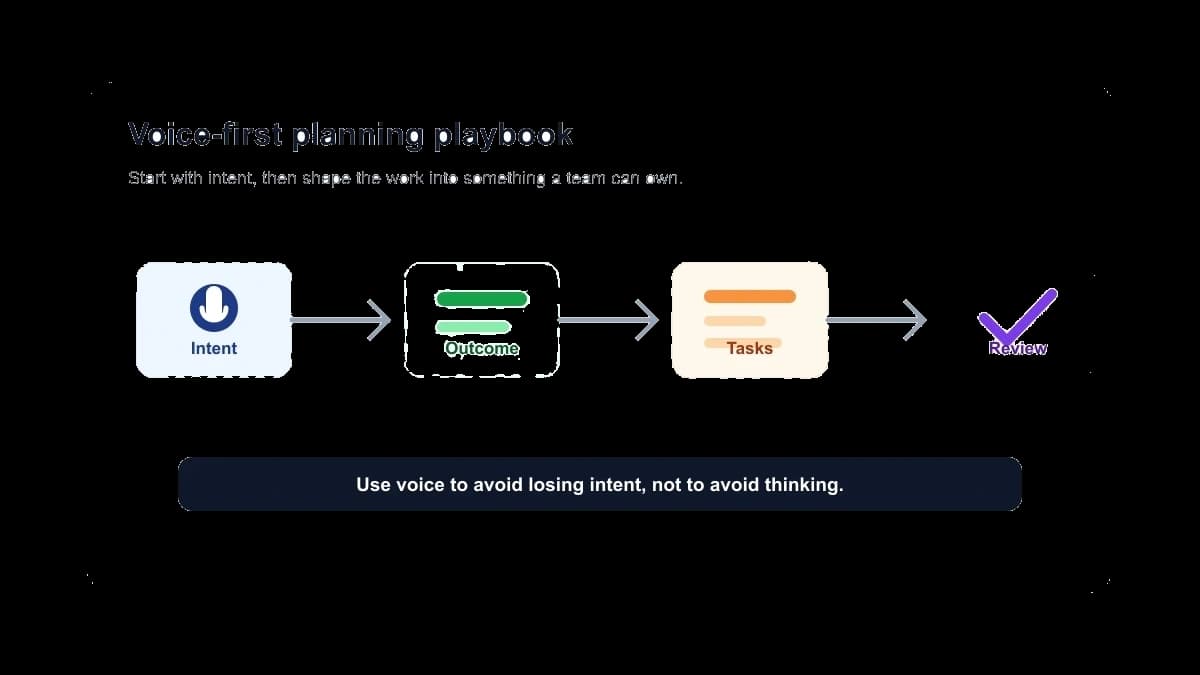
So the right workflow is not "speak and let the AI do everything." The right workflow is:
- Capture the intent quickly.
- Use project context to propose structure.
- Make the resulting change visible.
- Let the human confirm, adjust, or reject it when the action matters.
That is the balance I want Bisonflow to strike: faster capture without pretending judgment is optional.
How I Think About Voice in Bisonflow
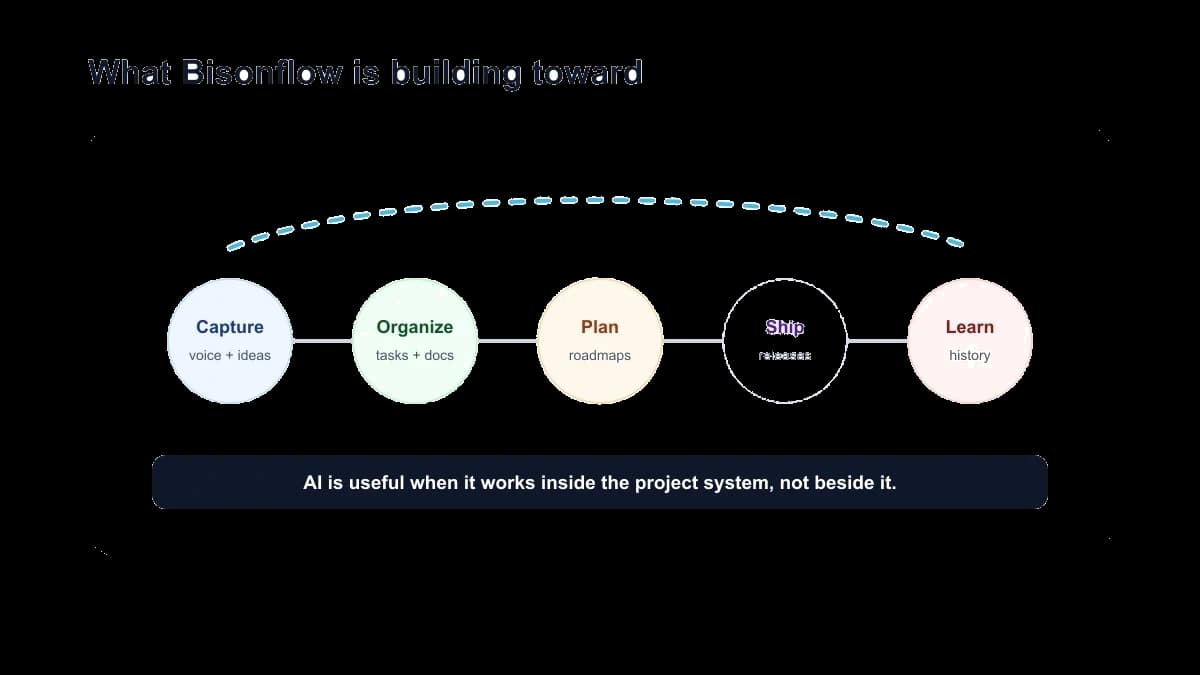
Bisonflow starts with tasks, docs, roadmaps, releases, and AI-assisted workflows in one workspace. Voice belongs there because project intent often appears before someone has the time or patience to structure it manually.
The product should help a builder say a messy thing and get back a useful project object. It should help a team member update work without digging through screens. It should help preserve the reason behind a task before that reason gets lost.
The long-term direction is straightforward:
- capture the thought naturally
- turn it into structured work
- keep it connected to the project
- make the result easy to review
That is not magic. It is workflow design.
The Practical Standard
Voice belongs in project planning only when it reduces the distance between intent and useful project state.
If it creates transcripts nobody reads, it is noise. If it creates tasks without context, it is backlog clutter. If it changes work without review, it is risky. If it helps a team capture the right thing at the right moment and keep it connected to execution, it earns its place.
That is the standard I am building toward with Bisonflow. Voice is not there to make project management feel futuristic. It is there to help work move from thought to delivery without losing the thread.
Anthony Abramo
Founder, Bisonflow
Building voice-first project operations for product and engineering teams.