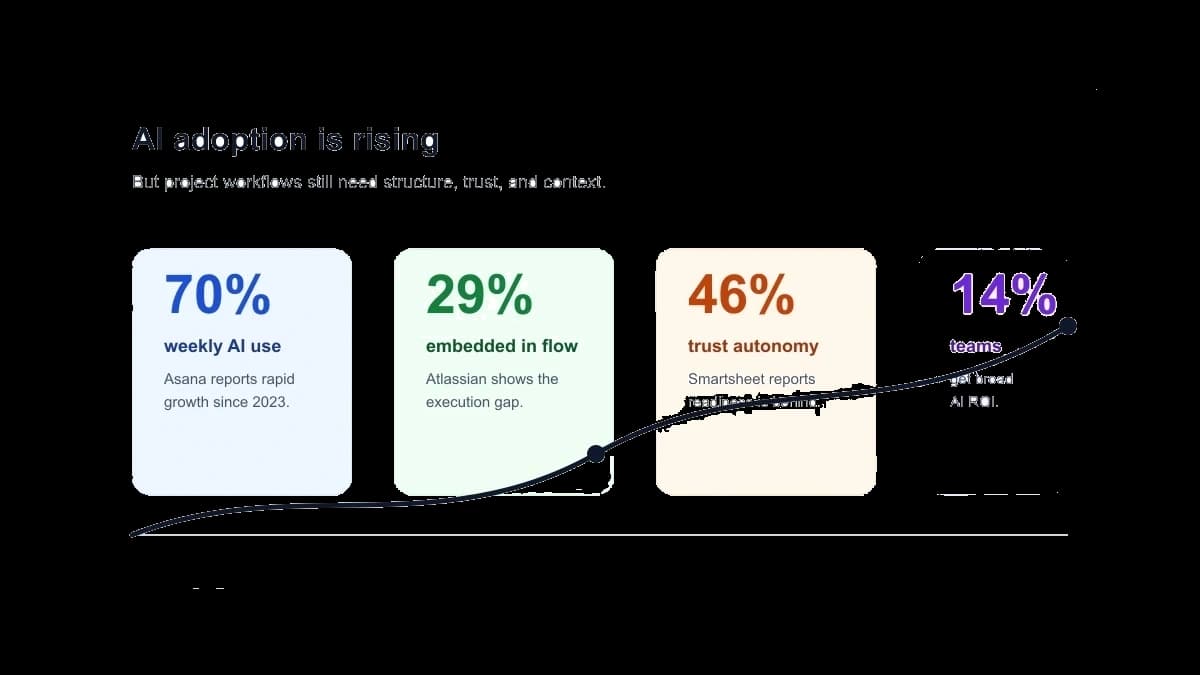
"AI project management software" is an easy phrase to say and a hard phrase to make useful.
For some products, it means a task list with an AI writing assistant. For others, it means generated status updates, meeting summaries, backlog cleanup, or a chatbot that can answer questions if the underlying project data is clean enough.
Those features can help. I use AI for plenty of practical work myself. But if that is the whole product direction, the category stays shallow. The team still has to manage the real project system by hand.
When I describe Bisonflow as AI project management software, I mean something more specific: AI should work inside the project system, with access to the structure, context, decisions, constraints, and delivery state that make project work real.
The Project Is More Than the Task List
A project is not a collection of isolated tasks. It is a moving system.
There are decisions, owners, dates, dependencies, docs, comments, priorities, roadmap tradeoffs, customer context, release plans, and the history of what changed. The task is only one visible piece of that system.
This is where many project tools create quiet friction. They store the work, but they do not always preserve the relationships around the work. A task says what needs to happen, but the reason lives in a doc. The decision lives in chat. The roadmap says something slightly different. The release plan gets updated later. The team meeting becomes the place where everyone reconnects the pieces.
That is not a failure of one specific tool. It is a workflow design problem.
The team becomes the integration layer:
- copying decisions into tasks
- turning meetings into follow-ups
- checking whether the roadmap still matches execution
- rebuilding context before making a tradeoff
- writing release notes from memory
- asking who owns the next step
- explaining the same project state in multiple places
AI does not automatically solve that. In some cases, it makes the problem louder because now the team can generate more project artifacts faster.
Generation Is Not Coordination
Most AI features are good at generation. They can draft, summarize, classify, rewrite, brainstorm, and answer questions. That is useful, but project delivery does not improve just because more text exists.
Teams ship when work becomes coordinated action.
That means the system has to help answer practical questions:
- What is the current priority?
- What changed since the plan was created?
- Which tasks make this roadmap item real?
- Which decision explains this work?
- What is blocked?
- What is ready to ship?
- What did we learn from the last release?
If AI cannot help with those questions, it is probably sitting beside the work instead of participating in it.
That distinction matters. A chatbot beside the work can write a good task description. AI inside the work can understand which project the task belongs to, why it exists, what status it should start in, which doc should be linked, whether it affects the roadmap, and whether a human should confirm the change before it becomes part of the plan.
That is the product direction I care about.
Context Has To Be a Product Primitive
Context cannot be treated as a nice-to-have layer on top of a task tracker. It has to be part of the product model.
For AI to be useful in project management, the workspace needs to understand project objects and their relationships:
- tasks and their workflow state
- docs and the decisions they contain
- roadmap items and the work that supports them
- releases and the tasks that shipped
- comments and the changes they explain
- owners and the next actions they are responsible for
- dependencies and the delivery risk they create
This does not mean every product needs to become a massive enterprise graph on day one. Bisonflow is early, and I am not pretending the first version solves every version of this problem.
But the direction matters. If the product model treats context as loose text, AI will mostly produce loose text. If the product model preserves the relationships between work objects, AI has a better chance of helping the project move.
That is why I keep coming back to project state. Not state in the narrow technical sense, but the human operating state of the project: what is true, what changed, what is blocked, what is decided, what is next, and what should not be forgotten.
Voice Is an Input Layer, Not the Product
Voice is part of Bisonflow because a lot of project intent appears before someone is ready to write a clean task.
A founder notices a launch issue while testing. A product manager hears an important customer detail on a call. An engineer sees a dependency while reviewing an implementation. A team member remembers a release note that needs to be captured before it disappears.
In those moments, the first version of the thought is usually rough. Voice can reduce the gap between noticing something and getting it into the system.
But voice by itself is not the product. A voice note that creates a pile of unstructured transcripts is just another place to clean up later.
The useful version is different:
- spoken intent becomes structured work
- a rough thought becomes a task, doc note, roadmap update, or release reminder
- the system uses project context to understand what the user means
- the user can review the result before it becomes truth
That is why voice and AI have to be grounded in the same project model. The product should not celebrate that it captured audio. It should care whether the captured intent became useful project state.
The Five Motions Bisonflow Is Built Around
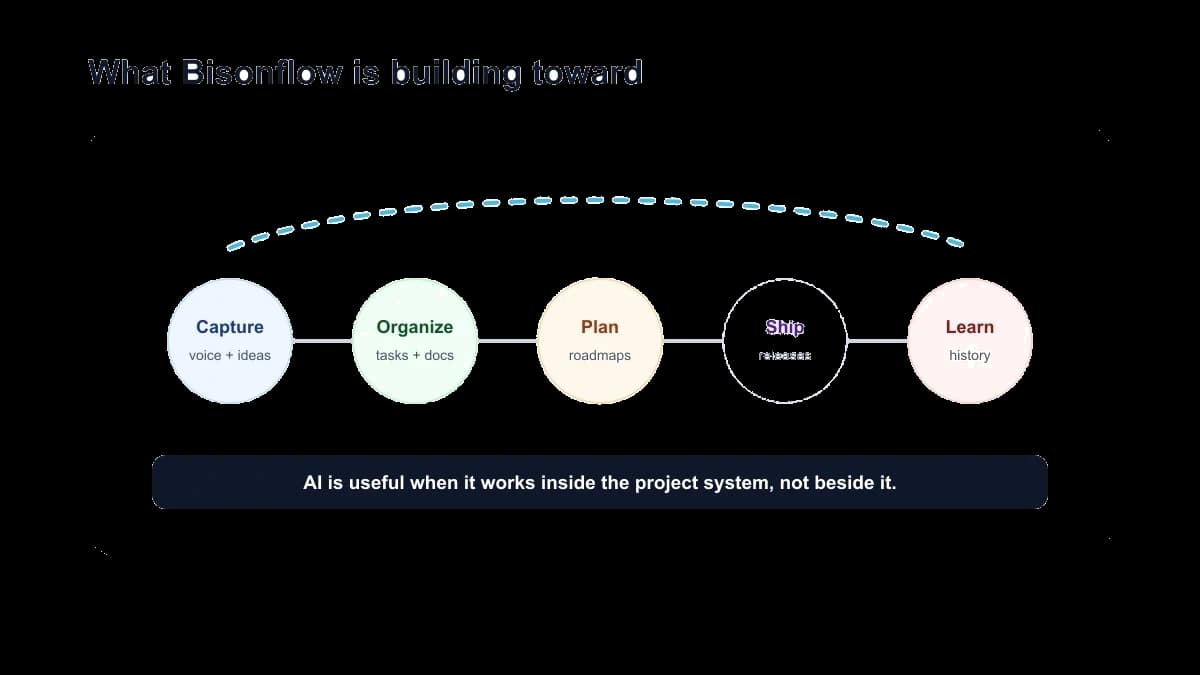
Bisonflow is being built around five connected motions: capture, organize, plan, ship, and learn.
These are not meant to be separate modules that happen to live in the same app. The point is that project work moves through these motions constantly, and the context should survive the movement.
Capture
Work often starts as a rough thought. Capture should be fast enough that the user does not lose intent while trying to format it.
This is where voice matters, but text capture matters too. The input method is less important than the outcome: the system should help turn intent into something structured enough to use.
Organize
Captured work needs shape. That means tasks, statuses, owners, priorities, dates, docs, comments, and views.
Organization should not feel like ceremony. It should make the next decision easier. If structure only exists because the tool demands it, the product is too heavy. If structure helps the user see what matters, it is doing its job.
Plan
A roadmap should not be a decorative artifact. It should help the team reason about sequence, dependency, timing, and delivery risk.
Planning is where project context gets tested. If the roadmap does not stay connected to the work, the team ends up with two realities: what the plan says and what the task board knows.
Ship
Shipping should leave a record. A release is not just a version number or a changelog entry. It is part of the team's memory.
When releases connect back to tasks and decisions, the team can explain what changed, communicate more clearly, support customers better, and avoid reconstructing history later.
Learn
The workspace should become more useful as real work moves through it.
Over time, the system should help show where projects slow down, which types of work create repeated friction, which releases changed scope, which docs keep being referenced, and where the team keeps losing context.
AI becomes more useful when it can reason over that history responsibly. The goal is not to remove judgment. The goal is to make judgment better informed.
What Bisonflow Is Not Trying To Be
Bisonflow is not trying to become a giant enterprise suite in the first version.
It is not trying to replace every tool for every company, force a heavy methodology, or use AI as decoration. It is also not trying to pretend that AI can remove the hard human parts of project work. Teams still need judgment, priorities, communication, and taste.
The first goal is more practical: make project work easier to capture, organize, plan, and ship without losing the context that explains the work.
That is already a large enough problem.
The Practical Standard
The standard I use for AI project management software is straightforward.
It should reduce the manual work of keeping project context alive.
That means it should help a user move from a rough thought to structured work. It should connect tasks to docs, roadmaps, and releases. It should preserve decisions and constraints. It should make delivery state easier to trust. It should let AI act where it has enough context and ask for confirmation where judgment is required.
If a product only creates more project-shaped content, it is not enough.
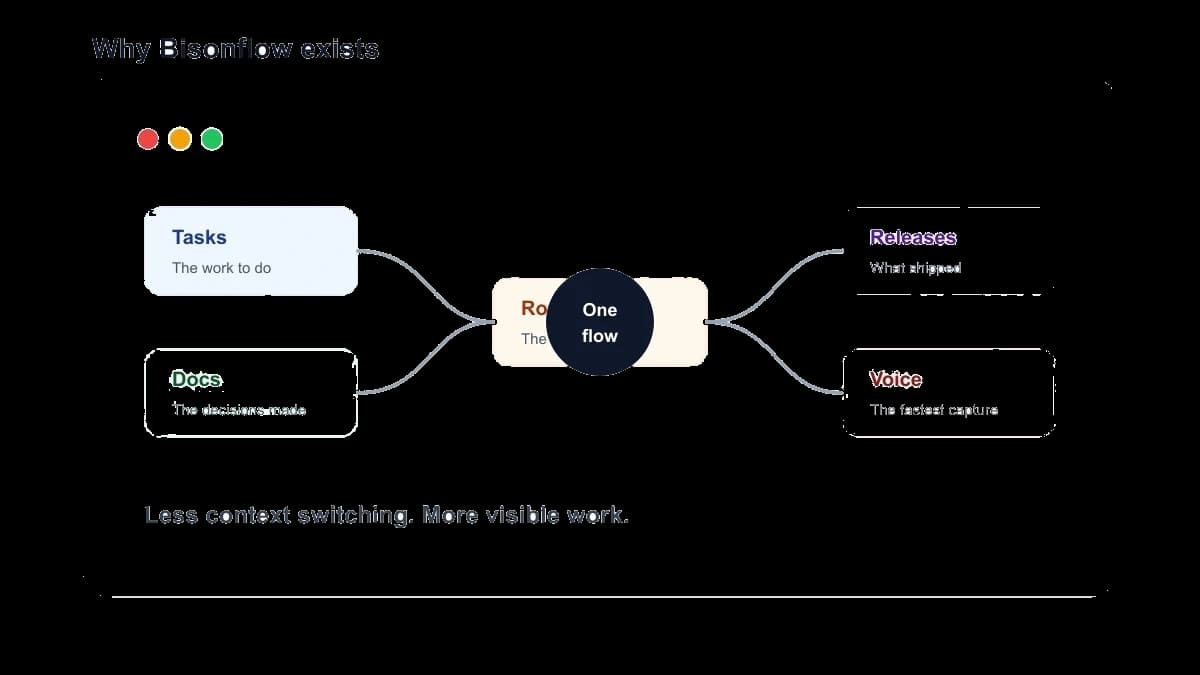
Bisonflow is my attempt to build toward the more useful version: a project workspace where AI, voice, tasks, docs, roadmaps, and releases are part of one connected flow from idea to delivery.
Anthony Abramo
Founder, Bisonflow
Building voice-first project operations for product and engineering teams.